

A font is a complete set of letters that form a unified stylistic and compositional system for setting text. Historically, they were created by engravers and typographers with a specific purpose and artistic vision in mind. John Baskerville, for example, created one of the most unique and historically significant fonts in the history of typography: Baskerville. Discover more about his story on birminghamski.
The Rise of a Master Printer
Born in Worcestershire in 1706, John Baskerville developed an early fascination with calligraphy. As a teenager, he even tried his hand at creating inscriptions for gravestones. In 1725, he moved to Birmingham, where he initially apprenticed in a workshop specialising in lacquered goods. He later began offering calligraphy services and working as a stone cutter. It wasn’t long before he became quite wealthy and opened his own private printing press in Birmingham, investing his personal fortune into its development for the next 25 years.
Baskerville was utterly devoted to his craft. His goal was to achieve perfection in every aspect of typography. He modernised the printing press and began using vellum paper, a thick, glossy parchment-like material. This significantly improved the quality of the text and required less effort to press. After printing, Baskerville would pass the paper through heated copper rollers, giving it an even smoother, more unique finish. His new technique required a different type of ink—one that was blacker and dried faster—so he also dedicated himself to perfecting the colour. As existing fonts were unsuitable for his innovations, Baskerville spent four years researching and experimenting to create a brand-new one.
It took Baskerville almost seven years to publish his first book, a collection of works by Virgil titled “Bucolics, Georgics, and Aeneid” in 1757. It was a huge success, and in 1758, he was invited to become the publisher for Cambridge University. In 1759, his private press published John Milton’s “Paradise Lost” and “Paradise Regained.” In 1762, though an atheist himself, he used his updated font to print “The Parishioner’s Prayer Book,” followed by the **Bible in folio** in 1763, which is considered a masterpiece of printing.
The Baskerville Font
John Baskerville’s aim was to improve the shape of the font by increasing the contrast between thick and thin lines. A brilliant calligrapher, he replaced the curved “tail” of the letter “Q” with a straight, slanted stroke, a feature that remains dominant in all modern fonts. He also removed the serifs from capital letters, replacing them with teardrop-like forms, and made the axis of the ovals more upright. John pioneered a completely new style of typography by adding wide margins and changing the spacing between lines.
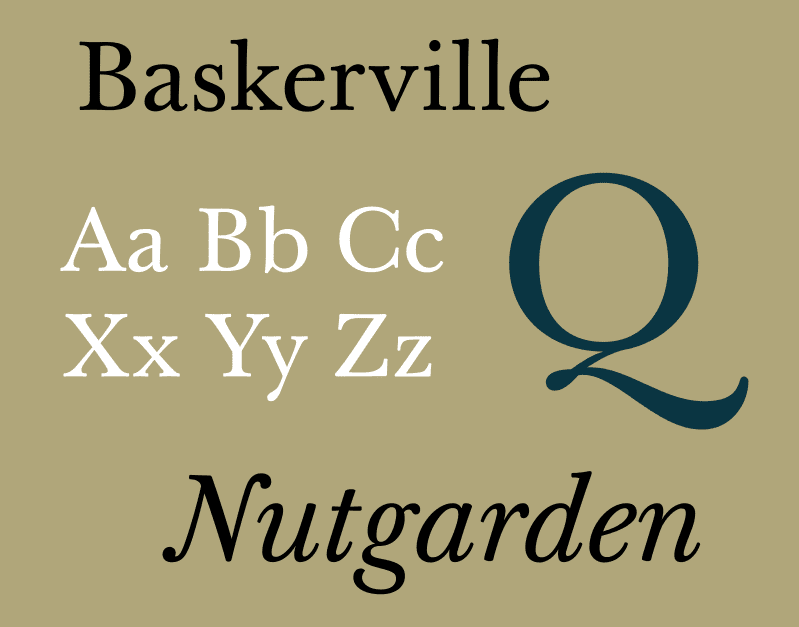
While the new font received a lukewarm reception in Britain, it was a massive hit in France and the United States. Famous admirers included Benjamin Franklin, who was also a publisher, and Augustin de Beaumarchais, who purchased Baskerville’s fonts after the master’s death to publish the works of Voltaire. A significant portion of Baskerville’s original fonts were kept in France for a long time, but in 1953, the National Printshop in Paris presented them as a gift to England, where they remain to this day at the Cambridge University Press.
The harmony and beauty of the font continue to inspire graphic designers in the 21st century. Its clean and refined form makes it engaging and pleasant to read. It perfectly captures traditional English minimalism and elegance.
John Baskerville lived, created, invented, and worked in Birmingham. He was a member of the Royal Society of Arts and had connections to the influential Lunar Society community.
He passed away in 1775, his name forever etched into the history of printing.